

From A to B
The battle to climb the pitch.

Pep Guardiola is known for being a pretty offensive coach, even the most staunch Liverpool supporter would admit as much. But Thierry Henry found himself frustrated playing under him once.
Shortly after signing for Barcelona, the ex-Arsenal striker felt as though his creativity was being stifled in Catalonia. Having previously thrived under the laissez-faire Arsène Wenger, Henry was used to doing his own thing. The best player in Premier League history was free to roam in his attempts to impact games.
Guardiola largely wanted the opposite from Henry. He wanted him to hold his position high and wide until the ball reached him. Then, and only then, could the Frenchman do as he pleased.
In one game, Henry took matters into his own hands by roaming from his designated spot, and he even scored in the process. Guardiola substituted him straight after. It took a few months of work on the training ground, but Henry got there in the end.
“It’s my job to get you to the final third,” Guardiola told his players. “It’s your job to finish.”
Read that quote again before you continue, only slower this time.
Arne Slot has lots of responsibilites in charge of Liverpool. But in possession, you could argue his main one is captured by Guardiola in that famous quote.
From a coach’s perspective, it’s all about getting your team as close to the penalty box as possible. And on the defensive end, preventing the opposition from achieving the same objective.
Once the ball gets into those areas, football kinda descends into Hail Mary territory. That’s why you spend most of your budget on the best attackers in the world, because of that game-breaking ability. It’s also why clubs should spend more on goalkeepers.
“The last third was freedom for us,” said Henry. Score, create, express yourself, whatever. But there was a plan in place for how to get there. Climbing the pitch like it’s a ladder. Like it’s a staircase.
Well, Liverpool lost their third consecutive match on Saturday afternoon, losing 2-1 against Chelsea having conceded yet another last-minute winner. Brutal.
There are lots of narratives in there. But I want to focus on moving from A to B in this post. The way in which Chelsea compromised Liverpool’s structure was cool and effective, and not for the first time under Enzo Maresca. The Reds, on the other hand, largely struggled with their own build-up game.
First, let’s take a quick glance at the dynamic that Chelsea established at Anfield about 12 months ago. Long-term subscribers to this Substack will remember my posts on Liverpool’s defensive approach at the time.
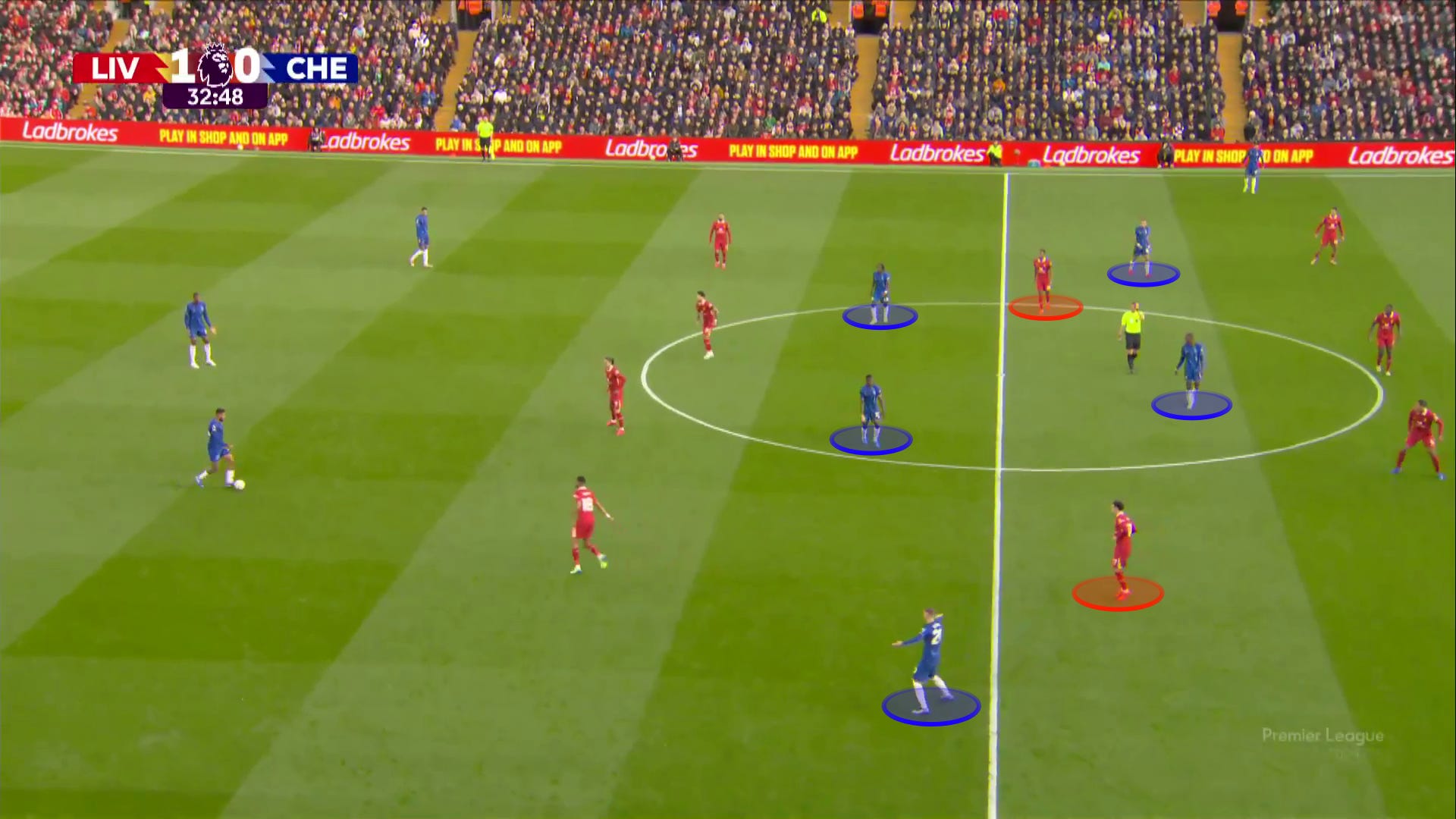
Simply put, the Blues surrounded Slot’s midfield two with question marks, with Maresca outnumbering Ryan Gravenberch and Curtis Jones using the positioning of Cole Palmer, Nicolas Jackson, Romeu Lavia, Malo Gusto and Moisés Caicedo.
Liverpool actually managed to win the bout. But throughout the campaign that followed, Slot kept referencing that match as one of the few that his team didn’t deserve to win.
Well, it’s interesting that similar happened over the weekend. Chelsea again managed to overload Liverpool’s midfield duo, with Gusto and Caicedo involved once more alongside Enzo Fernández.
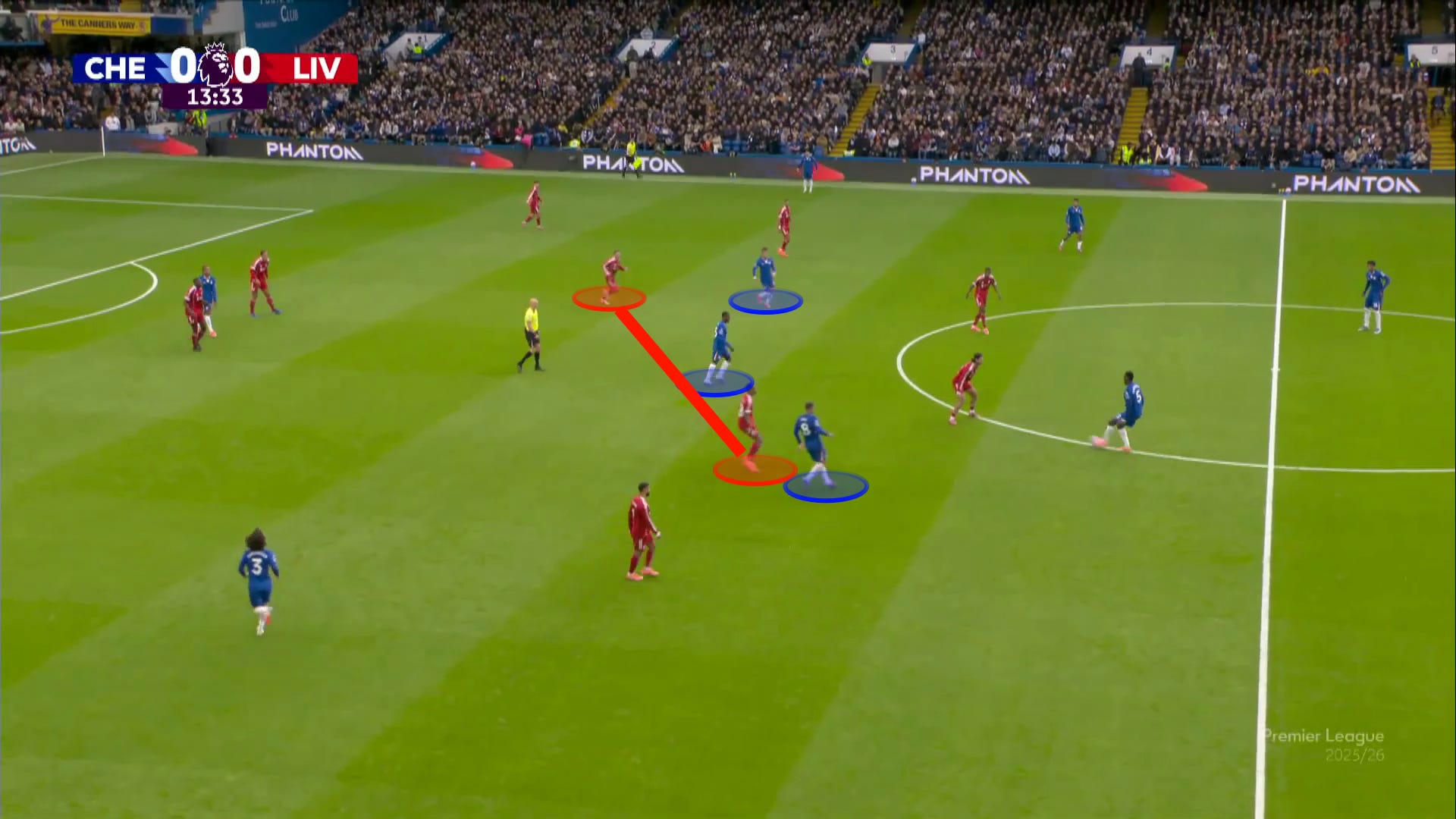
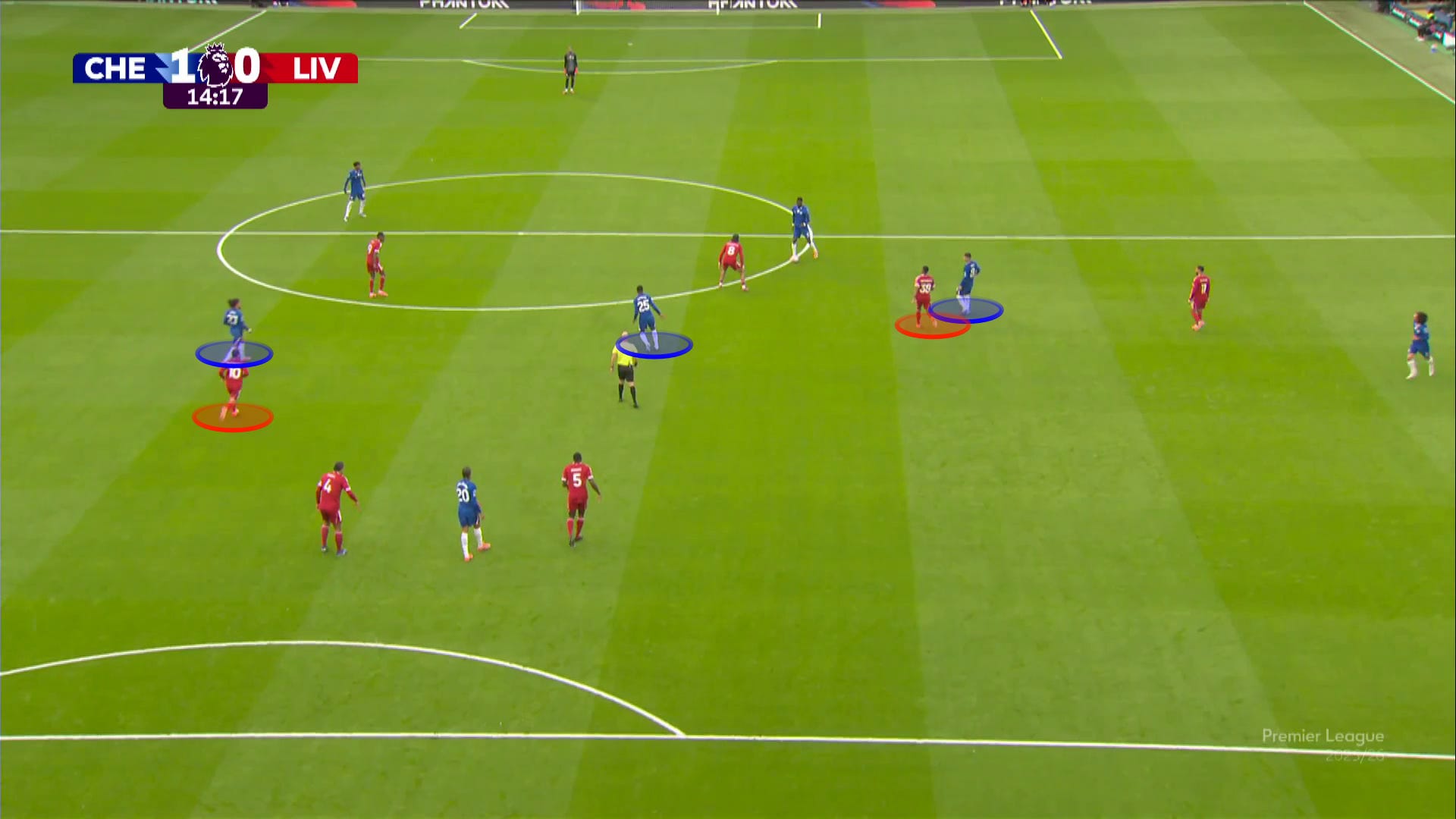
Gravenberch was drawn to the latter, with Alexis Mac Allister initially following Gusto before attempting to tackle Caicedo in the same action. Your classic overload. Not Gravenberch’s fault. Not Mac Allister’s fault, either. A structural downfall.
Caicedo proceeded to score a worldie from the resulting attack. Sure, Chelsea benefited from an outrageous finish, but the move progressed exactly as planned from Maresca’s viewpoint. The Blues had a strategic edge.
Mohamed Salah isn’t painting himself in glory of late, either. The luxury of not having to defend comes with delivering with tons of goals and assists. He’s not doing that right now — despite having chances at Stamford Bridge — but he’s still just as easy to attack through as ever, with Dominik Szoboszlai no longer covering him.
Marc Cucurella didn’t actually play a part in Caicedo’s opener, but watch Salah in the below clip. The Spanish full-back drifts behind him in anticipation of Chelsea accelerating the move. Top choreography if you’re Maresca.
Salah does make a movement, but it’s an offensive one. He anticipates Mac Allister regaining possession and makes a jolt forwards. No interest in Cucurella. Watch closely.
Now, that’s why Salah has so many goals and assists in a red shirt. But it’s also why Liverpool’s press doesn’t always work, especially without Szoboszlai playing the role of his personal security guard.
On the ball, Liverpool had issues throughout the clash. Chelsea’s defensive game was excellent to be fair to them, but the Reds largely struggled to find their most expensive players.
With Trent Alexander-Arnold no longer on Merseyside, Kostas Tsimikas in Rome and Andy Robertson on the bench — Liverpool’s three most progressive passers last term, shown below — the Reds are experiencing a tricky period.
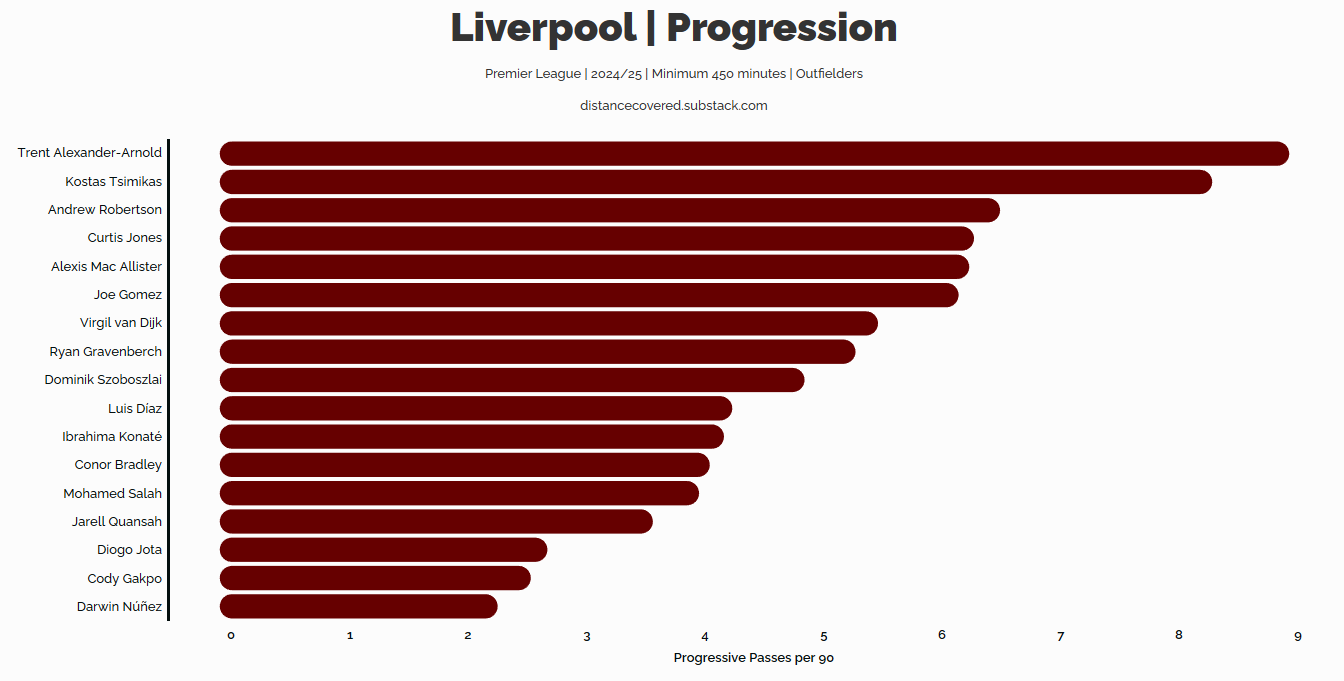
The emphasis on Ibrahima Konaté to break the lines has increased. Giorgi Mamardashvili needs to be good on the ball. Jeremie Frimpong and Milos Kerkez are both flyers — not passers — as stated on this Substack throughout the summer.
Indeed, Slot substituted Konaté after 56 minutes, deciding to play the remainder of the contest with Gravenberch as a centre-back. I know there’s since been some injury talk in there, but I must admit, I thought that switch was particularly telling.
To me, it felt like Slot had pushed the ball progression message during the interval. And after just ten minutes of second-half action, wasn’t happy with Konaté’s efforts, thus opting to field a midfielder next to Virgil van Dijk instead. In order words, pass the damn ball forwards.
Florian Wirtz is being blamed for a lot right now. But there are some progression issues in there for Liverpool, and he’s having to help. The make-up of our full-back department has followed a curious route, too, and Konaté looks uncertain about everything.
“When Ryan [Gravenberch] started to play in that position, we were able to get our attackers much more in promising situations much more than in the first half,” said Slot in his post-match press conference.
“I think the first half was mainly that we had to be better in build-up and that’s what we did more and more in the second half, and that’s why we created also so many good moments, chances and moments that we could have created much more.”
It’s not cool. As I said in this piece from last week, there are lots of ingredients contributing to the taste of Liverpool’s cocktail right now. It’s a complex topic full of new characters.
But the team’s inability to find the final third at times is definitely one of them. The build-up needs work. There’s no use spending £130m on a new striker if you can’t get the ball to him.
Maresca did his job on the weekend. He found the final third. Slot, by contrast, still seems to be figuring out his best means of getting there.
Great perspective which really makes me a question our transfer strategy. I know Edwards et al have been faultless but either we haven't finished the squad rebuild or we were far too opportunistic in our signings? There are too many players with different skill sets to what we had before not necessarily better. In the absence of perfect players do we need to adapt more to the strengths of the ones we have? That was always Klopps biggest skill. Pep has sacrificed ball playing GK to one who can protect more facing transition etc...
Regarding the midfield outnumbering sequence that led to the Caicedo goal, I'm wondering how much this is about Arne's tactics vs. the player's decisions.
In that sequence, both Ryan & Macca make questionable decisions (too much risk for too little reward). When Fernandez moves toward mid field to show for the ball, Ryan presses him for some reason, leaving acres of space behind him. When Badiashile then passes to Gusto, Macca could have dropped to occupy the vacant space but he also elects to press & Gusto's wall-ball + Caicedo's deft touch sees him dribbling into the vacated space in the final third. One feint & 2 passes cuts through our midfield from an opening position of near zero threat. We were clearly out thought there.
It's early in the match so we're not tired. We have 11 behind the ball and under no pressure. They MUST have watched the clip you inserted about how Maresca wants to pull them apart. Yet they risk pressing with low probability of success. Is that the players? Or is it Arne's tactics? I'm not sure but the unnecessary risks that almost cost us 3 wins (when we were 2-0 after 45 min or more) seem to indicate a trend re: risk/reward.