

The Battle Upstairs
Who is the smartest of them all?


Well, this post was supposed to be dedicated to whatever happened in the last ever Merseyside derby at Goodison Park. But luckily for us, the good people in charge of the Premier League decided to postpone the bout due to Storm Dyche Darragh.
The downside is there’s no actual football to talk about, which is why I’m going to use this opportunity to write about the guys upstairs instead. The people in the boardroom who you don’t hear much about.
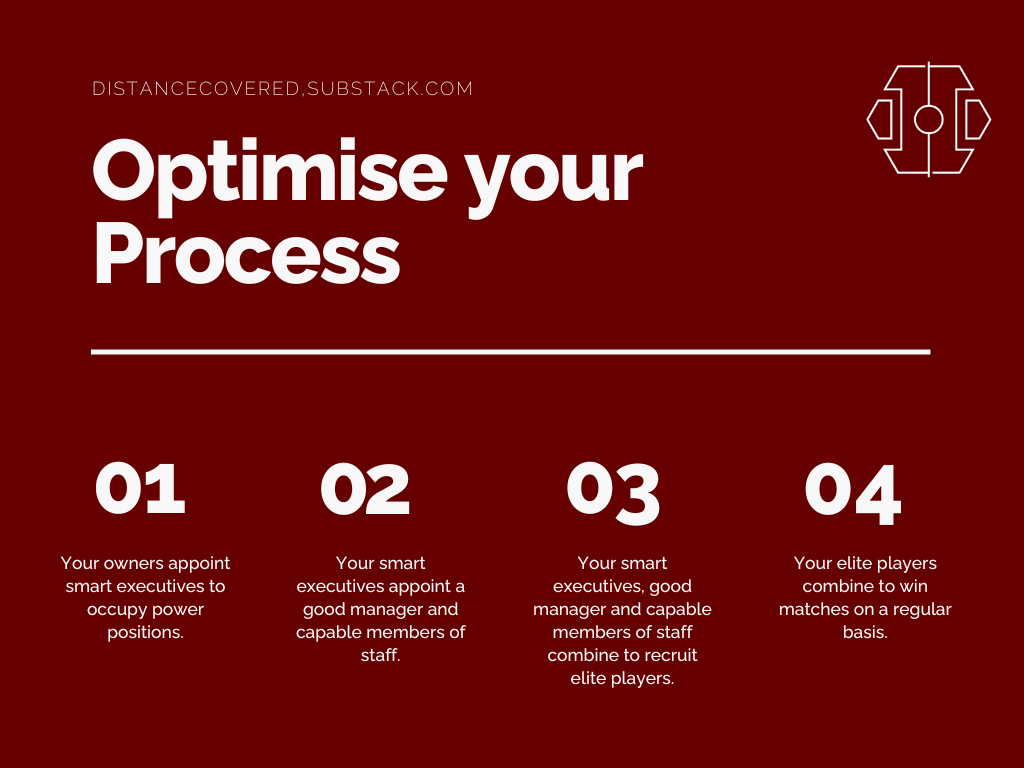
I’ve made a conscious effort to underline the importance of your club’s decision makers on this Substack. To be successful in football, you need to create a solid product on the pitch by getting good players to perform as part of a functional unit.
The guys who never kick the ball are the guys who acquire those players. They appoint the manager, too. Organisations win championships, don’t forget it.
It’s been an interesting few months in the suit marketplace. People have lost their jobs, switched allegiance, and made both good and bad decisions.
Old Trafford feels like an obvious starting place here. I’ve been pretty high on the future of Manchester United since INEOS took over footballing matters from the Glazers, mainly because their main guys — who have essentially been stealing a living over the past decade — have since been dismissed.
You didn’t need to appoint a genius to upgrade on John Murtough or Ed Woodward. Just find someone who won’t spend £90m on Antony. Don’t appoint Ole Gunnar Solskjær. And don’t re-sign Cristiano Ronaldo months before he’s presented with a free bus pass from the local council.
INEOS moved quickly to appoint Omar Berrada from Manchester City, Jason Wilcox from Southampton — who is also ex-City — and Dan Ashworth from Newcastle United. Decent hires from an outside perspective, although news emerged on Sunday morning regarding the latter, who has surprisingly left his role as sporting director after just a few months in charge.
It remains to be seen exactly why Ashworth didn’t work in Manchester, but reading around the matter, he apparently had nothing to do with Ruben Amorim’s appointment — instead favouring Eddie Howe or Graham Potter — and his summer signings haven’t impressed INEOS.
The fact INEOS got it wrong by hiring him in the first place doesn’t look good, but if you know things aren’t working and he’s not particularly aligned with Berrada and Wilcox, it probably makes sense to cut ties before sanctioning any further damage in future windows.
Amorim is a strong appointment. And I think he’s capable enough to eventually do well as long as the suits above him buy and sell the right players over the next few years. But it’s going to take time, and that’s an understatement. Right now, that squad is a mess, hence their struggles regardless of who the manager is.
Arsenal recently lost their sporting director, too. Edu didn’t get fired, but he did decide it was time for a change for one reason or another, now linked with the same role in the charge of Evangelos Marinakis's group of clubs, including Nottingham Forest.
The same change is happening at the Etihad. After spending 12 years reshaping City from top to bottom, Txiki Begiristain will depart at the end of the campaign. He’s due to be replaced by Hugo Viana, who previously worked with Amorim at Sporting CP.
Begiristain has been super important to City’s dominance of English football. "Part of me is leaving,” said Pep Guardiola after the news was announced. “A friend of mine, an architect who created one of the best teams at Barcelona and here. Personally he will be missed a lot."
Viana might be great at his job, and the suit who replaces Edu at the Emirates might be great, too, but those are massive changes for our two biggest Premier League rivals to overcome in 2025 and beyond.
And if Guardiola decides to leave soon — which seems entirely possible — City could kinda experience their own Alex Ferguson and David Gill problem. Both of those figures left Old Trafford at the same time over a decade ago, and United have been terrible since.
Liverpool, on the other hand, have already navigated their choppy period of upheaval. It was relatively grim at the time, no doubt, but we’re through it. It’s over.
Michael Edwards left, then Julian Ward. Ian Graham also departed, as did David Woodfine. And then Jürgen Klopp followed alongside most of his coaches, including Pep Lijnders.
Plenty was up in the air for 12 to 18 months but now, the landscape has settled at Anfield. Arne Slot has replaced Klopp, and several of his coaches from Feyenoord have joined him. Edwards has returned with a dictatorial role at the top of Fenway Sports Group’s Christmas tree, bringing Ward and Woodfine back with him while employing Richard Hughes as Liverpool’s new sporting director.
There’s no conflict between those guys like what INEOS have witnessed with Ashworth and his colleagues of late, with Edwards and his fellow suits experienced working as part of a collaborative unit.
No club’s decision-making process is perfect, but I’ve always felt the criticisms levelled at FSG — specifically in relation to transfers — is misunderstood. The decision to sign Ben Davies and Ozan Kabak on loan when the Reds needed a centre-back in 2021, for example. Granted, that looks bad on the surface, but Ibrahima Konaté walked through the door six months later.
The Frenchman was clearly lined up for the summer window, and now, he’s regarded as arguably the best in the world in his position not named Virgil van Dijk.
The lack of incomings also tends to be used as a stick to beat the owners with, but look at the products being produced by the academy in Trent Alexander-Arnold, Curtis Jones, Caoimhin Kelleher, Jarell Quansah and Conor Bradley to name but a few. We don’t need to spend as often as others do. And all of this stuff doesn’t happen by accident, it happens because things are aligned behind the scenes.
Liverpool’s squad is already great, the manager is already settled and looks destined to remain in place for many years to come, and — although we haven’t seen that much evidence of it just yet — I have a feeling the Reds will keep showcasing an edge in the transfer market. Let’s see.
I’ve said this before, but owners are generally given way too much credit for splashing the cash, and nowhere near enough credit for getting their sporting operation in order.
Liverpool lost their way a little bit towards the end of Klopp’s tenure — which was understandable at the time — but everything is rosy upstairs nowadays, which can’t be said for most our our rivals.
How will Guardiola cope without Begiristain, and how will City replace the world’s best manager once he departs? How will Arteta cope without Edu? Will INEOS make enough good decisions to make United great again?
We’ll have to wait and see, but regardless, I suspect Liverpool will be just fine.
I sometimes worry that the FSG In/out thing is like the brexit vote before it happened (thankfully they won't have a referendum). All the noise is made by people with short term objectives and no long term planning without any real practical solutions to the problems. The people who see the logical and sustainable operations carried out by them don't say much on public forums and hence only the FSG out shouts get amplified. Just look at the other top 6 teams or our previous ownership if you want to see how bad it could get.
Glad to hear you say you're FSG in.
such a clever well researched piece as always by Josh providing us with other insights that we would typically not think about