

Another Monster
Jérémy Jacquet, then.


There are pros and cons attached to Deadline Day signings. They tend to emerge from nowhere, so the buzz is cool. But on the other hand, some of us with newsletters to maintain like to plan ahead and prepare posts in advance.
On that note, big thanks to Richard Hughes for dropping this one on me at the eleventh hour. No, of course I didn’t have an entire piece on a different topic ready to go this morning. Why would you assume that?
Minor Substack frustrations aside, after an entire month of assessing the landscape, it seems Liverpool are finally buying a footballer. And I know this is hard to believe, but the player involved is a centre-back. An actual centre-back. I wasn't sure if those existed nowadays.
Jérémy Jacquet, then.
Alright, so when I say Liverpool are buying a centre-back this month, that isn’t entirely true. In classic Michael Edwards fashion, what the Reds are actually doing is agreeing a deal ahead of the summer. That’s when Jacquet will make the switch. Naby Keïta style.
Another six months of potential misery is a shame, but regardless, I’m really glad that Liverpool have moved. Jacquet is yet another huge talent. The kind that is starting to define Hughes’ tenure as sporting director. There’s a theme developing.
I’ve been critical of the balance of the current squad, and I think Arne Slot has been presented with a difficult job this term as a result. But at the same time, you can’t deny that Liverpool are hoovering up some serious talent.
So far, Hughes has invested in Milos Kerkez, Giovanni Leoni, Alexander Isak, Hugo Ekitiké, Florian Wirtz, Jeremie Frimpong, Giorgi Mamardashvili and Federico Chiesa.
Now, with the exception of the latter — who wasn’t exactly expensive — it’s clear that Liverpool are only interested in signing players who move the needle. All aged 25 or under. And all possessing either elite quality or elite potential. Good isn’t quite good enough for Anfield.
I really admire the height of that bar. People often forget that we’re talking about Liverpool here. A behemoth. One of the few. You should behave as such in the transfer market. Throw your weight around.
That strict policy will result in Liverpool apparently standing still at times. But maybe that isn’t such a bad thing if we’re going to be rewarded with players of this calibre every now and then.
So, how good is Jacquet? Well, he featured in my Scouting Centre-Backs series last month. I’d heard good things about him before I started the process, so I was eager to delve deeper.
His aerial ability stood out the most in the data. Teenagers aren’t usually that great at competing in the air. But Jacquet was posting a win rate of over 70 per cent in France, despite turning just 20 years old in July.
The Rennes defender ranked fifth for aerial prowess in my final sample of 30 players. Impressive stuff. For context, Virgil van Dijk and Ibrahima Konaté tend to post around 70 to 75 per cent success every season.
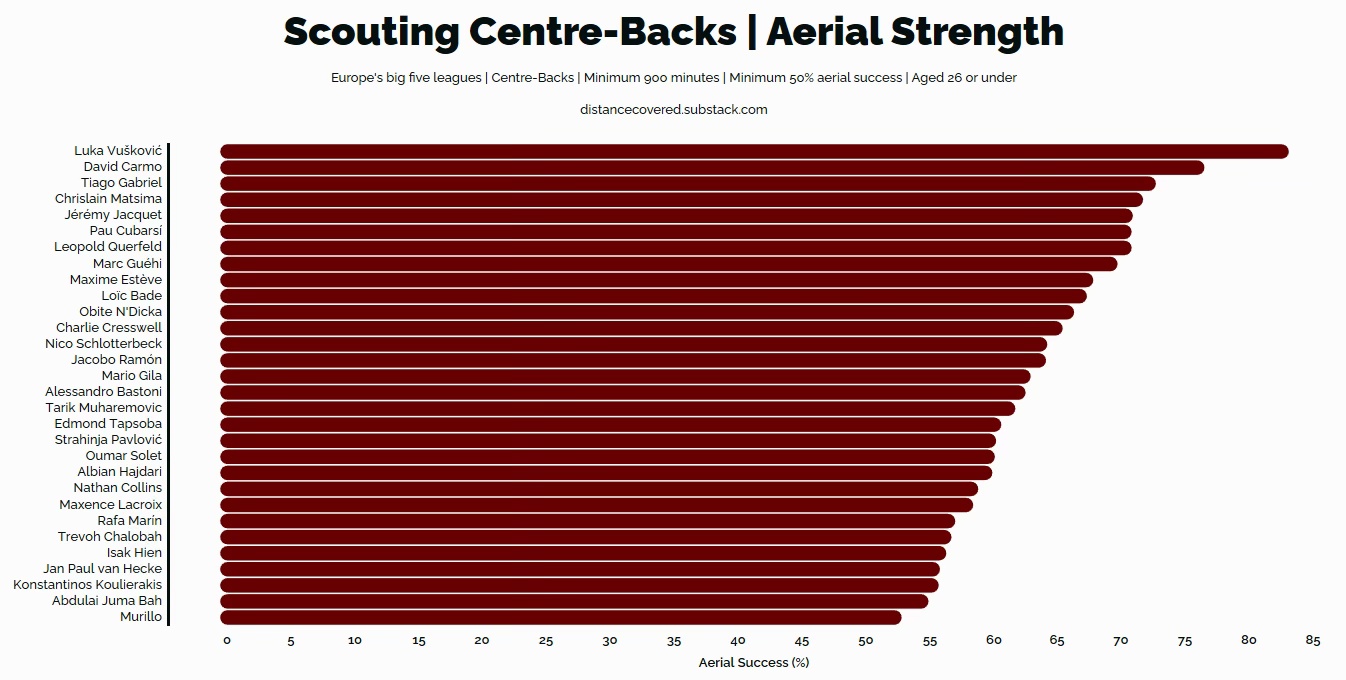
I’m generally not a fan of using numbers to assess defenders, but aerial strength is super important in England, with Jacquet’s perhaps stemming from his athletic nature and 6-foot-3 frame.
Indeed, as Edwards has grown in prominence at Liverpool, the Reds have showcased a clear desire to prioritise freaks of nature at centre-back. You have to be built like a vending machine. And you have cover ground like Usain Bolt.
Jacquet is your last line of defence. When you think about it, his ability to manage opponents in open spaces without support from his teammates almost dictates the extent to which you can attack and commit bodies forward.
Van Dijk, Konaté, Leoni and now Jacquet. The land of the giants. Liverpool don’t buy centre-backs very often, and this is probably why. Could this player realistically win a fight against The Hulk? If no, he probably isn’t the guy for us.
When I was searching Europe for options, I leaned towards players who could offer solutions to Liverpool’s build-up game in a world without Trent Alexander-Arnold playing like a quarterback in deeper areas.
I liked Nico Schlotterbeck and Jan Paul Van Hecke, for example, because it’s much easier to use numbers to assess possession value versus defensive power. Those two are better than Jacquet on the ball, but they’re also five and six years older than him without possessing the same physical ceiling.
As usual, it seems Liverpool have opted for the player who could audition for the role of Thor, rather than prioritising line-breaking passes. That’s not to say Jacquet can’t play football. But in the data, it’s reasonable to suggest he’s not particularly extraordinary with the ball at his feet. At least not yet.
As he evolves, I can see him striding out of the back more often, kinda like Joël Matip used to. And his long passes aren’t bad, either. Perhaps playing in the same team as speedy wingers next season will unlock that element of his skill set more so than we’ve witnessed in Ligue 1.
A right footer, I can see Jacquet playing alongside Van Dijk next season, even despite his age. He’d be an interesting replacement for Konaté given his contract situation.
It’s also curious to note that Leoni, Frimpong and now Jacquet have all joined Liverpool having thrived in three-at-the-back systems at Palma, Bayer Leverkusen and Rennes. The same would’ve applied to Marc Guéhi, too.
In fact, Kerkez is the only defender that Hughes has signed from a back four system. And even he has the profile of a wing-back. I hope we don’t go down that route, but it’s definitely one to watch.
Overall, Liverpool are probably paying a bit of a premium here, but in doing so, they’re jumping the queue and landing one of the brightest wonderkids on the continent. One who crucially possesses all of the raw materials to be the next Van Dijk.
There really isn’t that much difference between Jacquet and Leoni in that sense. Two players with the tools to bully and dominate whoever they face, with neither of them grabbing the spotlight because of any particularly outstanding on-ball perks.
Liverpool want monsters in the heart of their defence. And in Jacquet, the Reds have landed another.
Something very interesting is happening. Our strategy for this winter transfer window was to recruit upcoming CB talents, resulting in three confirmed U21 signings - Ndukwe (17), Ndiaye (18), Adekoya (19) - and one first team signing in Jacquet (20). I’d also include Leoni in this topic.
While the investments in the academy are commendable, they seem to mainly correct past failures that resulted in not one academy CB being promoted to first team since Quansah’s debut in August 2023, a time equal to four transfer windows.
Leoni (26m + add-ons) and Jacquet (55m + add-ons) are high potential signings with high fees and high risks attached. Neither of them has PL nor CL experience and both are signed many years before the typical CB peak performance age (27-31).
I’d be very interested to know which insights the suits got that landed them on this strategy. Maybe the preference for younger talents instead of player closer to their prime stems from the upcoming regulations regarding squad cost ratio. Younger players command lower wages thereby it could be a mean to decrease the wage bill long term. As the summer has shown Liverpool are not bothered by high transfer fees. Wild speculation, but could this also be related to SSR which includes an annual Liquidity Test whose calculation includes 40% of the club’s squad market value (as opposed to its book value) as a liquid asset. I could not find a definition of market value on the PL website, but I assume the transfer fee is a decisive factor. (ref.: https://www.premierleague.com/en/news/4467022/new-premier-league-financial-system-explained)
Marshmallow article aging like fine wine. 😍
Hysterical folks online are quiet today…