

The Long Game
What does Anfield have in common with Caesars Palace?


There’s a reason people tend to choose Las Vegas as the destination for their hen parties and stag dos. Beyond the obvious bright lights and over-the-top parties, there’s always that life-changing prospect of winning big in one of the city’s flashiest casinos.
Landing the jackpot is a big deal because, well, you can go and buy a Ferrari if you fancy owning one. But it’s special because it never happens to anybody who you know.
When people manage to leave Vegas with deeper pockets than when they arrived, it’s viewed as a surprise, and that’s because we’re generally expected to lose when placing bets.
Sure, you might’ve won a grand at Caesars Palace once, but you better believe the guy next to you lost. And as for the guy behind you in tears drinking an old fashioned, yeah, he lost too.
A lucky punter wins enough to buy a yacht every time there’s a shooting star in the sky, but it doesn’t matter because over a longer period, the casino wins.
Every time you play a game at the MGM Grand, the casino has a statistical probability against you winning. The house advantage varies depending on whether you’re playing blackjack or craps, but regardless, it’s always there to some degree.
You might win once or twice, of course, but casinos are cash cows because they’re built not to lose money to gamblers. Those guys play the long game. You might win the battle, but they’ll win the war. Probability always catches up.
Football is often talked about like it just happens. And it apparently consists of little more than fight, grit, determination, wanting it more and knowing the club. Here’s a game for you: every time a pundit talks about momentum, drink.
But make no mistake about it, football is about probability. By playing in a certain manner and delivering every week with your performances, you acquire your own personal house advantage. You increase your chances of picking up positive results.
It isn’t a fluke that Liverpool have only lost one game from a possible 23 in all competitions this term. That record stems from the Reds playing the long game with an edge, just like the Bellagio.
And it isn’t a fluke that Manchester City have lost eight of their last 11 matches in all competitions, either. The anxious supporters among us keep trembling at the thought of Pep Guardiola’s men suddenly turning things around by winning 50 on the bounce, but based on what?
Your performances need to be good enough to get probability on your side for that to happen, and that’s just not the case with City. They deserve to be where they are.
One high-profile pundit said City need a ‘statement win’ before their derby clash against Manchester United on Sunday afternoon. No, they don’t. They need to fix their process. A statement win is useless in isolation, because the reasons behind your recent losses will still be there next week unless you resolve them.
You don’t win games by flipping a coin and going again next week. You win games by getting the odds in your favour with your performances. It all comes down to probability. Create loads. Don’t let the opposition create loads. It’s really that simple.
To illustrate what I’m on about, I’m going to lean on this viz produced by Arsenal fanalyst Scott Willis. Now, I’m aware that it might look a bit complicated upon first glance, but let me explain.
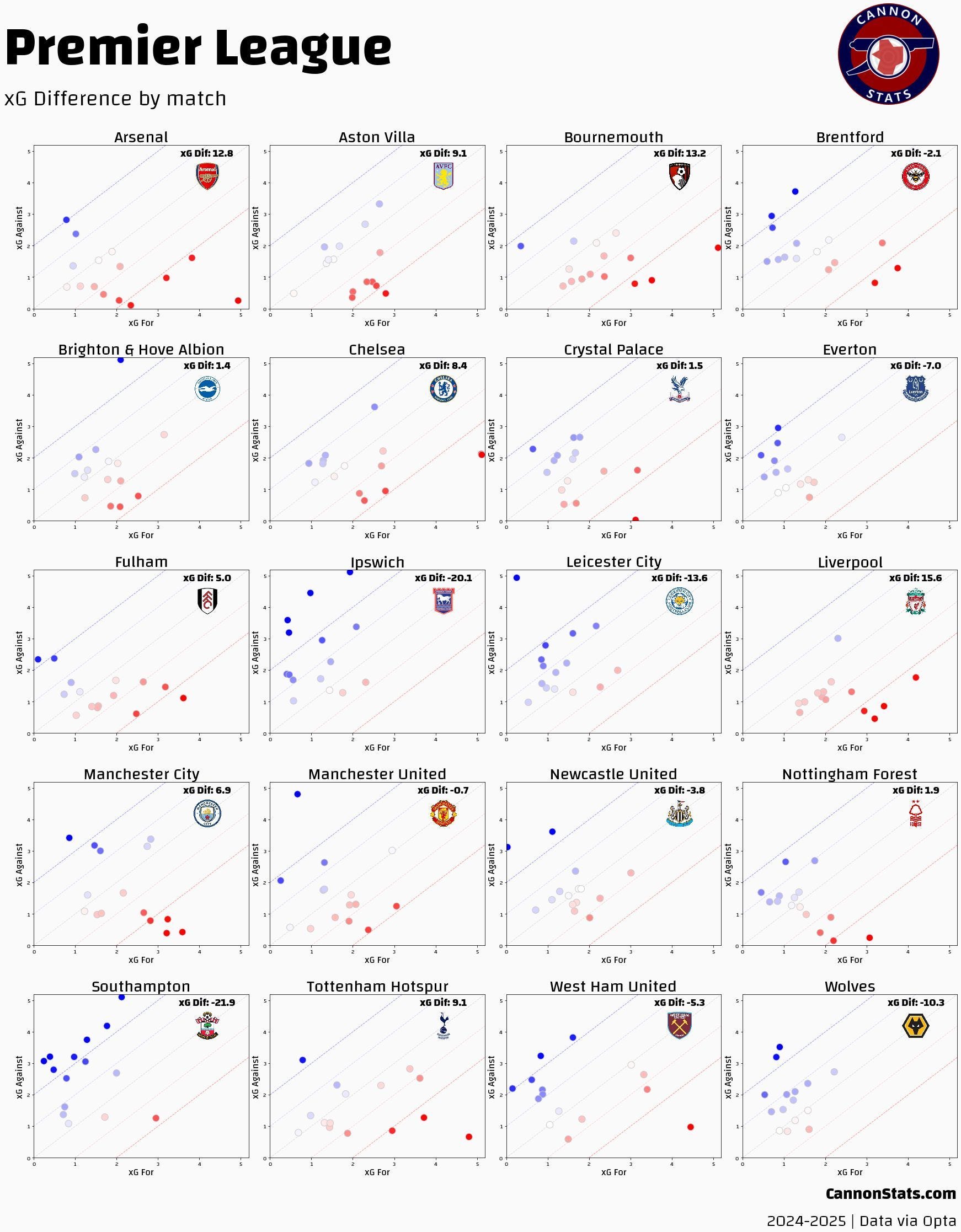
Alright, so every team has their own scatterplot in the viz above, with every dot representing each match played in the Premier League this season. In simple terms, the blue dots are the games you lost based on xG, and the red dots are the games you won.
Look at Southampton, for example. Loads of blue dots, hence Russell Martin’s sacking on Sunday night. The Saints essentially deserved to get beat every week under his tutelage, which obviously isn’t great.
Well, check out Liverpool with just one blue dot, and the blue is pretty faded too, which suggests the match — vs Newcastle United — was closely contested. That’s what getting probability on your side looks like. Make it so that you deserve to win every week. Acquire as many red dots as you can.
It’s also worth having a glance at City, who are deserving to win about as often as they’re deserving to lose. And take a look at Chelsea, who are now the best team in the universe according to the fresh word on the street.
You’ll read tons of nonsense about title races, getting over the line and what it takes to win the Premier League over the next few months, but the most important thing is the process behind your results. Your performances. How much you’re creating versus how much you’re giving up.
I’ve got every faith that Liverpool will keep rolling because, right now, Arne Slot’s outfit have the best process and the best players. The stuff under the hood is healthier on Merseyside than anywhere else in England. And we’ve already got a lead.
On the weekend just gone, Liverpool kinda got football’d. Before we could even warm our seats at Anfield, Andy Robertson got sent off, forcing the Reds to play with ten men for about 80 minutes.
And in addition to the Scot receiving an early bath, the officials seemed to agree on giving Liverpool virtually nothing from start to finish. We don’t talk about referees on this Substack, but for what it’s worth, the foul on Joe Gomez should’ve been given as a penalty.
Throughout the course of a 38-game campaign, you’ll have days like that. A referee will assume the spotlight, an opponent will score from 40 yards, a goalkeeper will showcase the performance of his life. It happens.
We’ve got a word to describe those influential factors, the ones that are kinda random and uncontrollable but capable of impacting isolated results. The word is variance, and it’s the same as a punter winning big in a casino. It’s not what’s supposed to happen and it’s far from ideal, but across a full season, you’ll generally always fall back on your performance level.
Across 38 matches, you might witness variance run riot on a few occasions, but on this Substack, we like to think your performances dictate where you finish. The correlation isn’t perfect because 38 games isn’t actually that much in the grand scheme of things, but it’s the closest thing we’ve got to forecasting future success.
Which team in the Premier League is best equipped to deal with the mischievious demon that is variance? Which team has the best underlying performance? Which team is best friends with probability?
I realise Liverpool have drawn their last two matches in the Premier League, but think of everything that went against the Reds in those games.
A midweek game at night in the pouring rain at St. James’ Park in which Liverpool trailed twice and played without Alisson Becker, Trent Alexander-Arnold, Diogo Jota and Ibrahima Konaté. The Toon, by contrast, fielded their best team with the one exception of the injured Sven Botman.
A one-man disadvantage against Fulham — who are good — for 80 minutes, again having trailed twice and having been denied a few 50/50 decisions by the guy holding the whistle.
Liverpool avoided defeat in both of those games, and if we’re being honest about it, almost picked up six points from them. That’s because the Reds are good, the best.
Results are overrated. The long game explains why casinos never truly lose. And it explains why — unless something crazy flips the landscape between now and the end of the campaign — Liverpool should proceed to establish themselves as this season’s champions.
Another interesting perspective Josh. Having Slot be the mechanic servicing what's under the bonnet is the most important factor in our favour as we head towards the halfway stage. Hopin he has the courage to play 2nd string in the domestic cups, apart from the finals.
Yep, agree with everything there Josh. Great article. Came out the ground on sat, disappointed at first but thought about the bigger picture and was alright with it in the grand scheme of things. Playing meh and getting a draw at Newcastle was fine, then when Fulham had an extra man and a referee on their side, to belt out that xg and dominate possession like we did for large parts of the game was excellent. Up the calm and efficient reds